
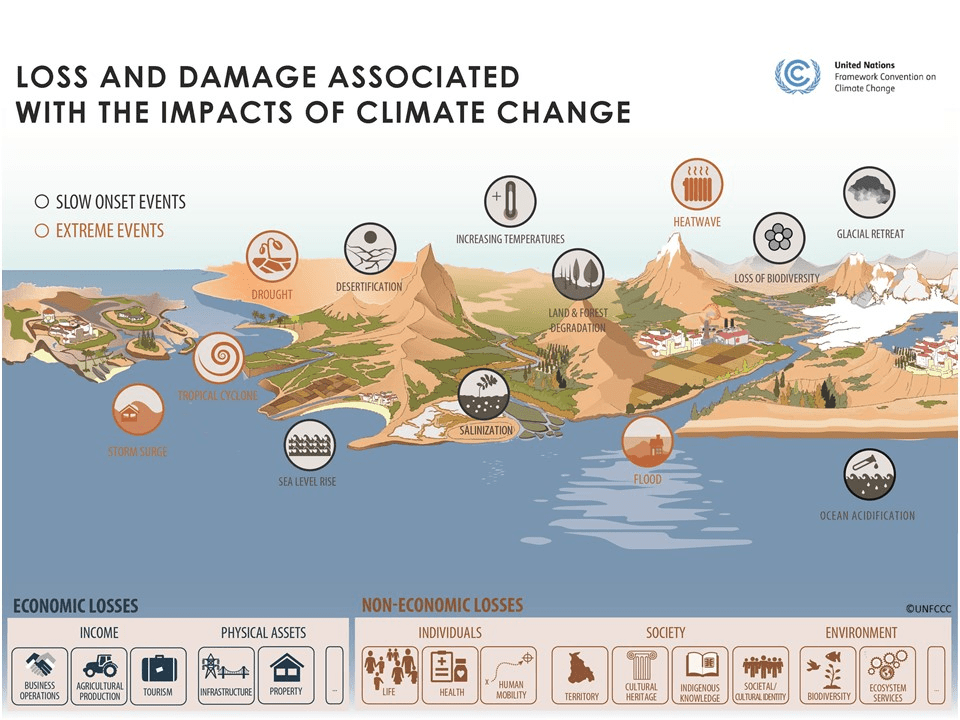
Loss and damage from climate change is no longer a future scenario but the lived reality for millions around the world. And yet, despite over three decades of multilateral negotiations under the UNFCCC, the legal and financial infrastructure to redress climate harms remains strikingly inadequate. The disconnect between the moral weight of climate harm and the multilateral policy responses offered is where the promise of international law begins to feel like a betrayal.
As the multilateral negotiations continue to defer responsibility for loss and damage, climate litigation and domestic liability frameworks are gaining traction as alternative avenues to seek redress. However, without a structural reparations approach that centers historical responsibility and systemic injustice, such efforts carry a risk of reinforcing existing global inequities. Reparations must aim not just to compensate, but to transform the underlying systems of harm.
This piece builds on my doctoral research and draws on reflections I shared in a recent keynote at the Climate Justice Think Lab at Leuphana University, as well as the inspiring discussions I had with fellow panelists at the Climate Reparations Conference hosted by the Law Faculty of the University of Montreal earlier this month. In it, I take a closer look at the limits of the negotiations, the origins of loss and damage, the rise of climate change litigation, and emerging domestic strict liability frameworks. I conclude with some thoughts on future directions, grounded in reparative justice.
The negotiation sphere
In 2013, Typhoon Haiyan hit the Philippines, killing over 6,000 people. At the same time, COP19 was underway in Warsaw. Yeb Sano, the Philippine lead negotiator – still awaiting news from his family – delivered an emotional speech, urgently calling for a meaningful outcome. He went on a hunger strike and was joined by some civil society participants, building critical momentum that contributed to the establishment of the Warsaw International Mechanism on Loss and Damage (WIM).
The WIM was celebrated by some as a turning point, but criticized by others, including myself, as an overly technical side process that offered to advance understanding and foster dialogue, while deferring meaningful action and support. It came to symbolise the broader dynamic of the negotiations: high stakes, urgency in the real world, mismatched with a continuous deferral of responsibility and action in the blue zone.
Despite more than 30 years of negotiations, global emissions continue to rise, and the window for limiting warming to 1.5°C is rapidly closing. Like the WIM, the operationalisation of the Fund for Responding to Loss and Damage (FRLD) has been hailed by some as a milestone; yet, it remains inadequate both in scale and structure. US$ 760 million has been pledged to date, with the majority from EU Member States, however, only US$ 260 million has actually been disbursed. This is negligible in comparison to the estimated US$ 400 billion required annually. In 2022, flooding in Pakistan killed over 1,700 people and displaced 33 million others, with economic losses estimated at over US$ 30 billion. The evident shortfall in financial support is staggering.
The FRLD is based on voluntary contributions, without any reference to responsibility for the climate crisis. The legacy of paragraph 51 of the Paris Agreement decision text – which affirms that the treaty’s provisions on loss and damage do “not involve or provide a basis for any liability or compensation” – continues to define the parameters of what is politically acceptable. This enduring logic and disavowal of responsibility also appears to inform ongoing efforts to operationalise the fund.
The proposed approach agreed by the Board of the FRLD prioritises government-to-government support, intermediaries and project-based activities – all points that have been criticized by civil society groups as unacceptable and essentially a betrayal of the Fund’s Governing Instrument agreed at COP28 in Dubai. This approach essentially excludes those most affected by climate impacts from directly accessing timely support and thus reinforces the same patterns of inequity that have marred global climate governance since the UNFCCC’s inception.
A history of injustice
The idea of a loss and damage fund was not new but dates back to the early days of intergovernmental negotiations for what became the UNFCCC. In 1991, Vanuatu, on behalf of AOSIS, submitted a proposal for an International Insurance Pool to provide financial insurance against sea-level rise. The proposal was innovative, drawing on liability regimes for nuclear and oil spill damage, but it deliberately avoided explicit language around liability. Instead, the insurance pool would act as a collective loss-sharing arrangement. Despite its visionary approach, the proposal did not survive into the final Convention text.
During the course of my doctoral research, I traced the development of the proposal, including interviews with negotiators, Secretariat staff, and civil society actors who were involved at the time. In early 1992, negotiation texts still included draft language that referred explicitly to compensation and responsibility. One bracketed paragraph explicitly stated that developed countries “shall compensate for environmental damage suffered by other countries or individuals in other countries.” This language, too, was removed under pressure from industrialised countries.
The adoption of Article 8 in the Paris Agreement in 2015, which recognises the importance of loss and damage, was accompanied by Paragraph 51, which explicitly excludes liability or compensation. Several small island developing states, upon ratifying the Agreement, submitted declarations stating that no provisions in the treaty or accompanying decision would preclude their recourse under international law. However, in practice, the exclusion clause has acted as a de facto taboo on compensation or reparations arguments under the UNFCCC, which has constrained the scope of negotiations on loss and damage to date.
Climate change litigation
Fifteen years ago, during an internship with a London-based NGO, I worked with a father of two who wanted to sue the British government for its failure to act on climate change. I was inexperienced and skeptical of the legal basis, the prospects of success, and perhaps of the very idea that the courts were the right avenue for advancing climate justice in lieu of multilateral cooperation. In hindsight, this could have been the UK’s first major climate case in the making, and a missed opportunity I continue to reflect on to this day.
Many are no longer waiting for the UNFCCC to deliver. Around the world, climate victims and civil society advocates are turning to the courts to seek justice where diplomacy has failed. As of last year, more than 2,600 climate litigation cases have been filed, the majority in the Global North, to hold governments and corporations accountable for climate-related harms. Among these are an emerging subset of “loss and damage” cases that focus on harms already suffered, rather than future risks.
The Lliuya v RWE case, in which a Peruvian farmer is suing a German energy utility for its contribution to glacial melt – putting his village at risk of harm through a glacial lake outburst flood –, recently underwent an evidentiary hearing with a decision expected in May on whether the case will proceed to full trial. If successful, it could set an important precedent for corporate accountability under domestic tort law.

During my fieldwork as a participant observer in the climate negotiations five years ago, I observed that some negotiators at UN climate meetings were unaware of developments in the courts. Others were outright dismissive, suggesting that such cases were unrelated to the negotiation process. Others, yet particularly from civil society, actively engaged in litigation-related side events outside the blue zone. The disconnect between the negotiations and the courtrooms echoed a similar disparity to that between the negotiations and the real-world consequences of climate change. In recent years, litigation has become more prominent in political strategy. The threat of legal action has been adopted by some negotiators from the Global South as a means to intensify political pressure.
The push for advisory opinions from international courts and tribunals – delivered by the International Tribunal for the Law of the Sea, and pending from the Inter-American Court of Human Rights and the International Court of Justice – may further clarify the obligations of states in relation to climate change. These proceedings are expected to enhance the arsenal of litigation advocates, thereby strengthening legal mobilization efforts in regional and domestic courts. They may affirm the right of affected communities to seek redress for loss and damage.
Their potential notwithstanding, addressing climate harms through the courts carries a risk of focusing heavily on narrow legal arguments and monetary compensation, sidelining broader structural questions of colonialism, racial injustice, and historical responsibility that lie at the heart of reparative climate justice. In other words, they risk framing climate justice as a technical, financial, or state problem, not as a global systemic issue rooted in a history of exploitation whose structures and legacies persist today.
Mushrooming strict liability mechanisms
While the judges deliberate, alternative approaches are emerging at the domestic level. In the United States, several federal states – including Vermont and New York – have enacted climate superfund laws modelled on the federal Comprehensive Environmental Response, Compensation, and Liability Act. These laws impose strict, retroactive liability on large fossil fuel producers, requiring them to contribute funding for adaptation, resilience and/or loss and damage.
Such mechanisms vary across states but generally apply to entities responsible for more than one billion metric tonnes of GHG emissions over a defined period. The funds are intended to support infrastructure, disaster response, and resilience projects, though some also include mitigation components. Several other states have introduced similar bills, with cost recovery targets ranging from US$9 billion to US$75 billion.
Vermont and New York have passed such laws; others are pending in California, Maryland, and beyond. The idea is simple: hold corporations accountable based on their historical emissions, regardless of intent. Some bills even calculate damages through 2045.
These frameworks aim to internalise the costs of climate harm, but they raise concerns from an equity perspective. These superfunds primarily benefit US residents, rather than those in the Global South facing existential loss, in countries that may not have the financial means and welfare systems to support climate victims. In effect, the climate superfunds may reinforce global inequalities by enabling wealthy states to recover the costs of adaptation and loss and damage while those least responsible for the climate crisis remain excluded from meaningful remedies.
That being said, the future and prospects of the US climate superfunds are shrouded in uncertainty. Other federal states and fossil fuel advocates have initiated legal challenges. Twenty-two states have sued New York, arguing that the superfund law is preempted by federal law. Industry groups have also launched lawsuits. Earlier this month, President Trump issued an executive order directing the Attorney General to intervene in cases involving such state laws and related litigation efforts.
Opposition has been swift: industry lawsuits, lobbying, and – most recently – a Trump executive order instructing federal intervention against such laws. The fossil fuel backlash is real. But so is the momentum.
Conclusions and future directions
At the Climate Reparations Conference in Montreal, I spoke alongside scholars and activists engaging with the structural dimensions of climate injustice. Central to our discussions was the question of how to design and implement reparative frameworks that extend beyond finance and address deeper questions of power and historical responsibility, considering, amongst other aspects, the lasting legacy of colonialism.
In my new role as Climate Research and Policy Advisor at the African Futures Lab, I hope to explore how a reparations-based framing can inform the work of scholars, practitioners, and communities engaged in climate justice. The Lab is committed to unearthing the connections between racial justice, gender justice, and the climate crisis. When tackling climate reparations, I draw heavily on the brilliant work of scholars such as Maxine Burkett, Julia Dehm and Sarah Riley-Case, and Olúfẹ́mi Táíwò. Reparations, in this sense, are not just about money. They are about restructuring relationships, dismantling systems of harm, and amplifying the voices of those most affected.
I am particularly interested in how racial injustice shapes our understanding and narratives of climate harm, both in law and in practice. Too often, African perspectives are marginalized by dominant Western voices in crucial discussions on climate justice – whether in policy spaces, academia, or social movements. A question posed by an opponent during my doctoral defense captured the core of my motivation: she asked how my Haitian and German heritage informs my work. I believe this is an ongoing conversation that I will continue to have throughout my career. Personally, it serves as a reminder to use my work and position as a platform for those voices that are systematically excluded.
So I would like to end by reiterating this call:
If you are working at the intersection of climate justice and reparations – especially from the African continent or diaspora – do reach out to me and my colleagues at Afalab, we would welcome the opportunity to learn more about your work and explore possibilities for collaboration.


Leave a Reply